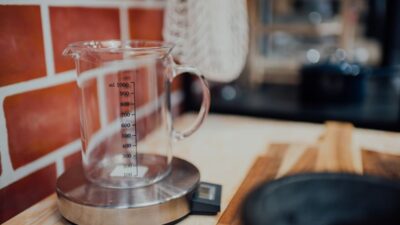

How many oz in a cup is a question worth understanding fully, not just memorizing, because the same number applies differently to water, flour, sugar, and butter.
This guide covers the conversions, the table, and the ingredient-specific differences that explain why the same cup measurement produces different weights.
1. How Many Fluid Oz in a Cup?
In the US measurement system, 1 cup equals exactly 8 fluid ounces (fl oz). This is a volume measurement, not a weight measurement. It applies to any liquid: water, milk, juice, oil, or broth. The fluid ounce measures how much space the liquid takes up, not how heavy it is.
For most practical cooking and baking in the US, the answer is clean and fixed: 1 cup = 8 fl oz. The table below covers the full range of cup fractions you will encounter in recipes.
| Cups | Fluid Ounces (fl oz) | Milliliters (mL) |
|---|---|---|
| 1/8 cup | 1 fl oz | 30 mL |
| 1/4 cup | 2 fl oz | 60 mL |
| 1/3 cup | 2.67 fl oz | 79 mL |
| 1/2 cup | 4 fl oz | 118 mL |
| 2/3 cup | 5.33 fl oz | 158 mL |
| 3/4 cup | 6 fl oz | 177 mL |
| 1 cup | 8 fl oz | 237 mL |
| 2 cups | 16 fl oz | 473 mL |
2. Understanding Dry Ounces vs. Liquid Ounces
This is where most confusion originates. Fluid ounces and dry ounces share a name but measure different things. Understanding the distinction prevents measurement errors that affect the texture and outcome of baked goods in particular.
2.1 Fluid Ounces (Volume)
A fluid ounce measures volume. It tells you how much space something occupies. When a recipe says ‘8 fl oz of milk,’ it is telling you to fill a measuring cup to the 1-cup line. The weight of that milk happens to be close to 8 ounces, but the instruction is about volume, not weight.
2.2 Dry Ounces (Weight)
A dry ounce measures weight. It is the same unit as the ounce you see on food packaging. When a recipe says ‘4 oz of cheddar cheese’ or ‘6 oz of dark chocolate,’ those are weight measurements. You need a kitchen scale to measure them accurately, not a measuring cup.
The number that confuses people: 1 fluid ounce of water weighs almost exactly 1 ounce. This coincidence holds for water but breaks down immediately with denser or lighter substances.
2.3 Why Recipes Can Be Confusing
US recipes often write ‘oz’ without specifying ‘fl oz’ or ‘dry oz.’
For liquids, “oz” often refers to fluid ounces, although recipes and packaging should ideally specify “fl oz” to avoid confusion.
The ambiguity creates real problems when a recipe lists ‘8 oz of flour’ without clarification, because 8 fl oz and 8 oz of flour are very different amounts.
European recipes typically use grams throughout, which eliminates this confusion. If you bake frequently and want consistent results, a kitchen scale removes all ambiguity for solid ingredients.
>>> Read more: How to Get Rid of Textured Skin? Simple Skincare Tips
3. How to Convert Oz to Cups (and Vice Versa)
Two formulas cover every conversion you will need in a standard kitchen.
3.1 Simple Formula to Use
- To convert fluid oz to cups: divide the number of fl oz by 8. So 12 fl oz divided by 8 equals 1.5 cups.
- To convert cups to fluid oz: multiply the number of cups by 8. So 2.5 cups multiplied by 8 equals 20 fl oz.
These work reliably for liquid volume measurements. For solid ingredients measured by weight, the formula does not apply directly because a cup of each ingredient contains a different weight of material.
3.2 When to Use a Scale Instead of a Cup
Use a scale for flour, sugar, butter, cheese, and any recipe that specifies weight rather than volume. The difference matters most in baking, where precision affects texture.
A cup of flour measured by scooping can weigh anywhere from 120 grams to 160 grams, depending on how tightly it is packed. A kitchen scale removes this variable entirely.
For liquids and loose ingredients like rolled oats or rice, cups are convenient and accurate enough for most cooking. The issue is primarily with dense, compactible solids.
4. Why Ingredients Don’t Always Convert the Same Way
The same 1-cup measure holds different weights of different ingredients. This is density at work, and it explains why a recipe written in volume measurements cannot be directly translated to weight measurements without ingredient-specific conversion factors.
4.1 Water vs Flour
If you’re asking how many oz is in a cup of water, then one cup of water weighs 8.3 oz (about 237 grams). One cup of all-purpose flour weighs approximately 4.25 oz (about 120 grams) when lightly spooned and leveled. That is roughly half the weight of water in the same cup volume. The flour takes up the same space but weighs far less because the air between the particles reduces its density.
4.2 Sugar vs Butter
How many oz are in a cup of sugar, you ask? One cup of granulated white sugar weighs about 7 oz (200 grams). One cup of packed brown sugar weighs about 7.5 oz (213 grams). One cup of unsalted butter weighs about 8 oz (227 grams).
The butter is close to water in weight per cup because it is a dense, solid fat with minimal air content. The sugar is close in weight because it settles tightly in the cup.
4.3 Density Makes a Difference
The practical takeaway is this: cups are a reliable unit for liquids and a convenient but imprecise unit for solids. When a recipe demands precision, such as in pastry, bread, or cake baking, a kitchen scale is the right tool. When a recipe is forgiving, such as in soups, stews, or casual cooking, cup measurements are efficient and good enough.
5. FAQs
How Many Oz Are in a Half Cup?
A half cup equals 4 fluid ounces (118 mL). This holds for any liquid in the US measurement system. For solid ingredients, 4 fl oz by volume does not equal 4 oz by weight. A half cup of flour weighs about 2.1 oz, while a half cup of water weighs about 4.2 oz.
How Many Oz in 2 Cups?
Two cups equals 16 fluid ounces (473 mL). The formula is simple: multiply the number of cups by 8 to get fluid ounces. For weight, it depends on the ingredient. Two cups of water weigh about 16.7 oz. Two cups of flour weigh about 8.5 oz. Two cups of granulated sugar weigh about 14 oz.
Is 8 fl oz Always Equal to 1 Cup?
In the US measurement system, yes. One US cup is defined as exactly 8 US fluid ounces. This relationship does not hold in other countries. An Australian cup is 250 mL (8.45 fl oz), a Canadian cup is also 250 mL, and a UK imperial cup is 284 mL (10 fl oz).
How Many fl oz in a Cup of Coffee?
A standard US ‘cup’ of coffee is typically 6 fl oz in the coffee industry, not 8. This is why a 12-cup coffee maker produces about 72 fl oz, not 96. Coffee makers use a 6 fl oz cup as the standard serving size.
Conclusion
How many oz in a cup? For fluid ounces in the US, the answer is always 8. For dry ounces, the answer depends entirely on the ingredient’s density, which is why a scale is more reliable than a cup for solid ingredients in precision baking.