

Learning how to check tire pressure takes about five minutes, and the only tool required costs under $15. Done monthly, it is one of the most cost-effective maintenance habits available.
This guide covers every method, from using a gauge at home to checking at a gas station, plus what to do when you have no gauge at all.
1. Before You Start
Three things to know before attaching a gauge to the valve stem. Getting these right means the reading you get is accurate and useful.
Find the recommended PSI. The correct tire pressure for your car is printed on a sticker inside the driver’s door jamb or in the owner’s manual. For example, if you’re wondering how to check tire pressure on Honda Civic, you’ll find the recommended PSI on the driver-side door jamb sticker rather than on the tire sidewall.
Check tires when cold. Driving heats the air inside the tire, which raises the pressure reading. A tire checked after extended driving may read several PSI higher than its cold pressure.
Choose the right tool. A digital gauge is the most accurate and easiest to read. A stick-style gauge is less precise but reliable enough for routine checks.
2. How to Check Tire Pressure (Step-by-Step)
The process is the same for all four tires. Work through each one in sequence rather than checking one and moving on.
Step 1: Find your recommended PSI.
Check the door jamb sticker before touching the tires. Note the front and rear PSI values, as they sometimes differ on performance vehicles and some SUVs.
Step 2: Remove the valve cap and attach the gauge.
The valve stem is the small rubber or metal protrusion on the inner edge of the wheel. Unscrew the cap and keep it somewhere you will not lose it. Press the gauge firmly and squarely onto the valve stem.
Step 3: Read the pressure and compare to the recommended PSI.
The gauge displays the current pressure. Compare it to the value on your door sticker.
If the reading is within 1 to 2 PSI of the recommended pressure, the tire is generally considered adequately inflated, though you can top it off to the exact specification if desired.
If it is more than 2 PSI below target, add air. If it is above target, release some.
Step 4: Add or release air as needed.
Use a portable compressor or an air pump to inflate. Add air in short bursts and recheck after each burst. To release air, press the small pin inside the valve stem using a pen tip or the back end of the gauge cap. Check the pressure again after releasing.
>>> Read more: Free Charity Cars: From 3 Legit Community Resources
3. Checking Tire Pressure at a Gas Station
Most gas stations provide air pumps for public use. The process differs slightly because the pump has its own gauge built in.
Step 1: Park and locate the air pump.
Park close enough that the pump hose reaches all four tires without stretching. Check the hose length before positioning the car. Many drivers get it right for three tires and cannot reach the fourth.
Step 2: Check pressure and add air.
How to check tire pressure at gas station, you might be wondering? The process is quite easy to handle.
Use your own gauge first to get an accurate baseline reading for each tire. Then use the pump to inflate to the target PSI. Stop slightly below the target and recheck with your own gauge for the most accurate result.
Step 3: Recheck and replace valve caps.
After adjusting all four tires, do a final check of each before leaving. Replace every valve cap firmly. A missing valve cap can allow dirt and moisture into the valve stem, potentially affecting the valve over time.
4. When You Don’t Have a Gauge
Knowing how to check tire pressure without gauge is useful as a temporary measure. Neither method below replaces an actual reading, but both can identify a serious problem that needs immediate attention.
4.1 Method 1: Use Your Car’s TPMS Warning Light
Most passenger vehicles sold in the United States since the 2008 model year are equipped with a Tire Pressure Monitoring System (TPMS). A warning light shaped like a tire cross-section with an exclamation point typically illuminates when one or more tires are significantly underinflated, often around 25% below the recommended pressure.
The limitation: the TPMS only alerts you when pressure is already significantly low. A tire at 28 PSI when the recommendation is 35 PSI may not trigger the light, but it is still meaningfully underinflated. TPMS is a warning system, not a measurement tool.
4.2 Method 2: The Hand Press Method (and Its Limits)
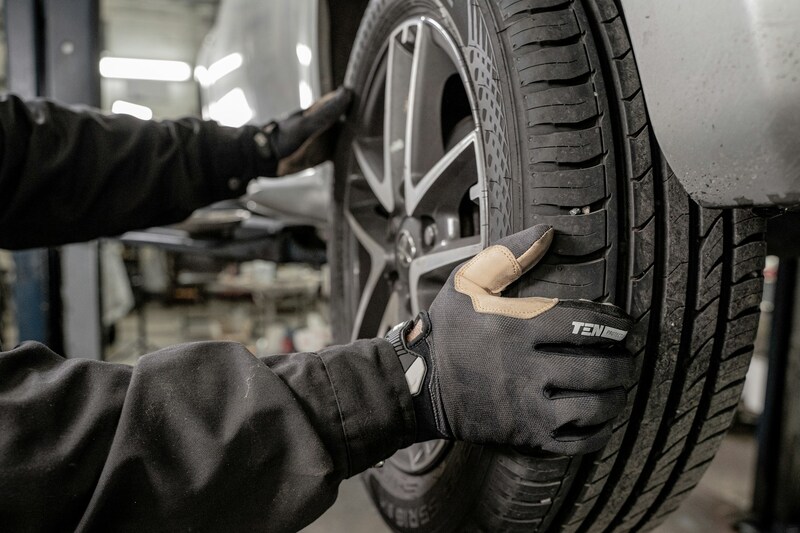
Pressing the flat of your palm firmly against the tire sidewall gives a rough indication. A properly inflated tire feels hard with no give. A severely deflated tire will yield under firm hand pressure.
This method only identifies near-flat tires. Even a tire that is substantially underinflated may feel normal to the touch, making this method unreliable for determining actual pressure.
Use these no-gauge methods only when a gauge is genuinely unavailable. At the earliest opportunity, use an actual gauge for the real reading.
5. Common Tire Pressure Mistakes
These four errors compromise the accuracy of how to check your tire pressure or the health of the tire.
- Reading the tire sidewall instead of the door sticker. The number on the sidewall is the maximum safe pressure, not the recommended operating pressure. Inflating the sidewall number can overinflate the tire by 10 to 20 PSI.
- Checking tires after driving. Heat from driving raises pressure artificially. Always check cold tires for an accurate reading.
- Ignoring temperature changes. Tire pressure drops about 1 PSI for every 10 degrees Fahrenheit of temperature decrease. A tire correctly inflated in summer may be 5 to 6 PSI low by January without any puncture.
- Forgetting the spare tire. The spare sits unused until urgently needed, which is exactly when you do not want to discover it is flat. Be sure to check the recommended pressure for the spare tire separately, as compact spare tires often require much higher PSI than the vehicle’s regular tires.
6. FAQs
How Often Should You Check Tire Pressure?
Once a month and before any long trip. Monthly checks catch the gradual pressure loss that happens naturally through the valve stem and tire material.
Before a long trip, underinflated tires create heat buildup at highway speeds that increases blowout risk.
Does Tire Pressure Change With Temperature?
Yes. Pressure drops approximately 1 PSI for every 10 degrees Fahrenheit of temperature decrease, and rises at the same rate when temperature increases. This is why tires inflated correctly in summer are often low in winter. Check and adjust pressure when seasons change, not just when the TPMS light comes on.
What Does It Mean When the TPMS Light Comes On?
One or more tires have dropped approximately 25% below the recommended PSI. Pull over when safe and use a gauge to check all four tires to identify which one is low. Multiple tires can be underinflated simultaneously, particularly after a cold snap. Inflate to the correct PSI and the light should turn off within a few minutes of driving.
7. Conclusion
Regular tire pressure checks are a small maintenance task that can make a noticeable difference in your vehicle’s performance, safety, and tire lifespan. Once you know how to check tire pressure correctly, the process takes only a few minutes and requires minimal equipment.
For the most reliable results, always use the recommended PSI listed on the driver’s door jamb sticker, check your tires when they are cold, and use a quality tire pressure gauge whenever possible.
By making tire pressure checks part of your routine, you can help maintain better fuel efficiency, promote even tire wear, and enjoy greater peace of mind on the road.